Can Horses Show Self-Control Around Food?
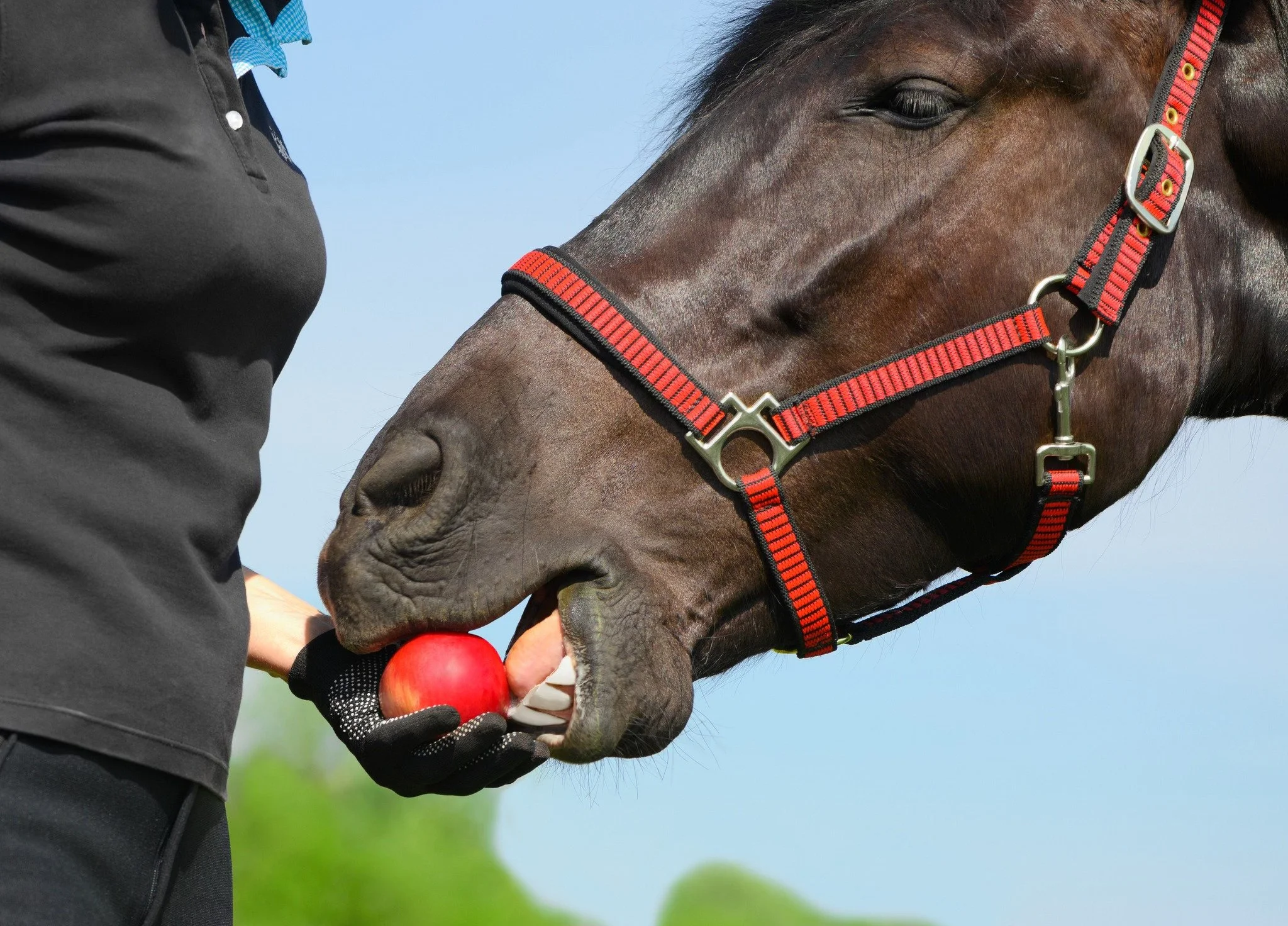
When food is involved, we often assume horses have no self-control. But research suggests that some horses are surprisingly good at waiting for a better reward.
Self-control is the ability to restrain one's own impulses or emotions. It has been widely studied, revealing enormous variation between and within species. However, there has been little research into self-control in horses. As a grazing species that eats for most of the day you might expect them to show low self-control around food, however their social complexity could be linked to high self-control abilities and more advanced cognitive skills.
Researchers in Germany explored this by testing the self-control of 82 horses using a delayed-gratification task. Each horse stood loose behind a barrier while a human held two different treats: a low-value reward available immediately, and a higher-value reward that could only be accessed if the horse waited. If the horse took the low value treat, the human removed the high value one.
In a later phase of the experiment, the set up became more challenging. The human held both treats, but only presented the low-value one close to the horse’s nose, while the higher-value treat was visible but out of reach. Over time, the researcher held the higher value treat for longer before making it available to the horse. So the horse needed to decide whether to take the low value treat immediately, or wait for the tastier one to be presented.
In the first part of the study, 20 horses waited up to the maximum delay of 60 seconds. In the second phase, only two horses managed to wait the full minute. Overall, horses waited an average of about 13 seconds. Some were highly impulsive and couldn’t wait even two seconds, while others regularly waited 30 or 40 seconds.
Unsurprisingly the feeding management of the individual horse mattered. Horses that were fed ad-lib hay tended to wait longer for the higher-value reward. Horses that had restricted forage were more impatient, suggesting that their relationship with food reduced their patience around food – perhaps their feeding routine left them frustrated or hungry.
Horses that showed coping behaviours – such as looking away, moving their head, pawing, or increasing their distance from the food – were more successful at waiting. The horses also appeared able to anticipate how long the delay was likely to be.
The researchers were surprised by how long many horses were willing to wait, given that horses rarely need to delay gratification in natural feeding contexts where food is usually abundant and easily accessible.
These findings suggest that horses can show self-control in ways comparable to other domesticated species. This matters for welfare and handling. Horses with better self-control may cope more easily with challenges such as novel environments, busy competition settings, or changes in routine. Waiting for food may also have real-world relevance in social grazing situations, for example, choosing to wait for access to a fresh hay pile rather than settling for lower-quality forage elsewhere.
So, if some horses can wait a full minute for a better reward – what else might they be capable of when we give them time, choice, and the right conditions?
Study: Brucks, D., Härterich, A., & König von Borstel, U. (2022). Horses wait for more and better rewards in a delay of gratification paradigm. Frontiers in Psychology, 13, 954472.